RESEARCH
| BENCHMARKS · ALGORITHMS · OPEN PROBLEMS |
The science behind
spatial general intelligence
Nexma Research is the long-horizon work behind Jax. Benchmarks for spatial reasoning, algorithms for hybrid optimization, the math of agentic computer vision, and the open questions still in front of the field. Papers, datasets, and code — published where they help the next group ship faster.
NEXMA 07 · RESEARCH
We work on the questions
that have to be answered
before the next decade ships.
Spatial general intelligence is a research program before it is a product. There are algorithms missing, benchmarks unwritten, ontologies still under construction. Nexma Research exists so the answers to those questions don’t stay locked inside a single company. We publish the benchmark, release the dataset, write the open problem down. The faster the field moves, the sooner the physical world gets the operating layer it’s waiting for.
And this is what that means:
Open by default. Reproducible by design.
Everything we’ve published.
- DR-2026-0022026-05
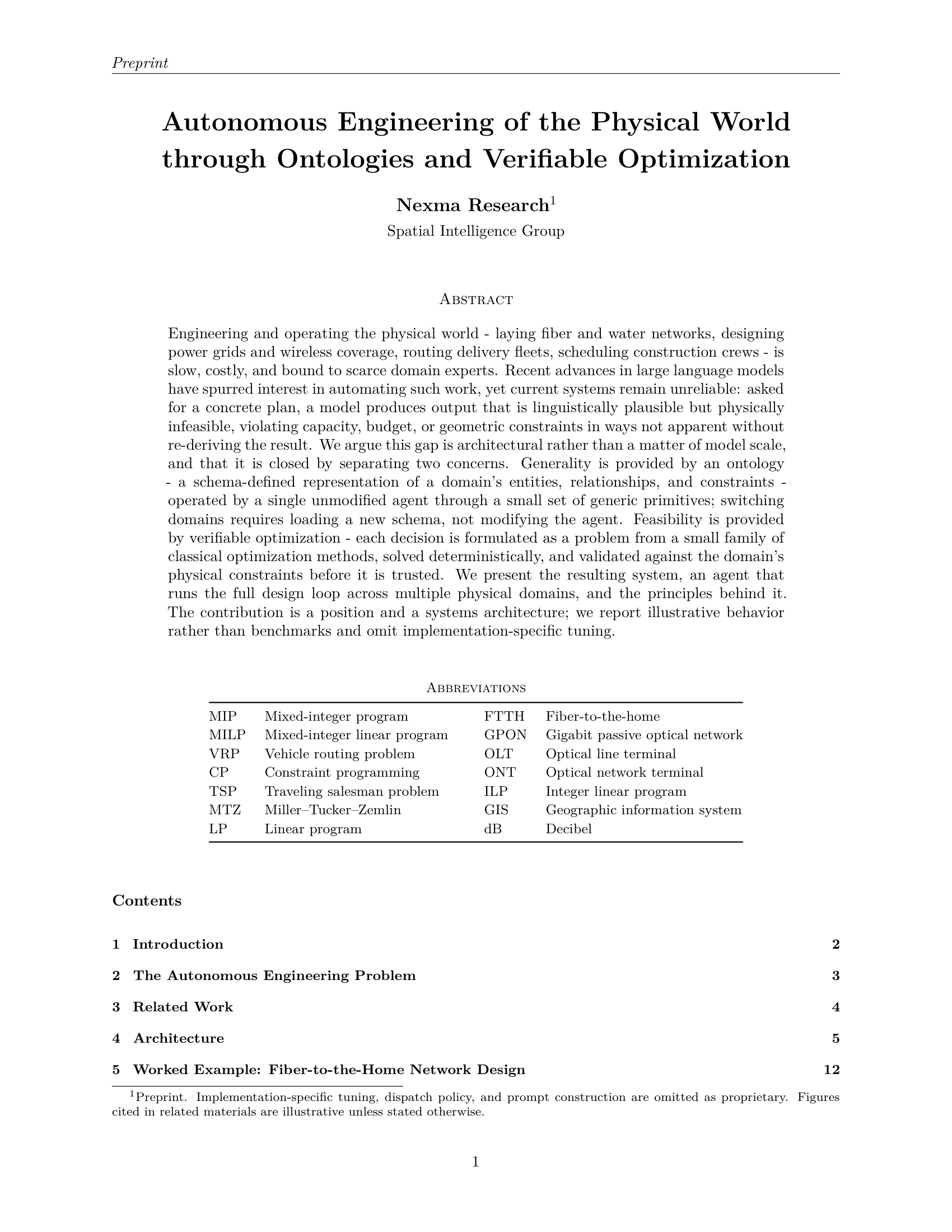
Autonomous Engineering of the Physical World through Ontologies and Verifiable Optimization
Nexma Research · Nexma Research Preprint · PDF
- DR-2026-0012026-03
Toward Spatial Reasoning in Large Language Models: Benchmarks for Physical Infrastructure Planning
A. Aviv · Nexma Research Preprint
More work, more often. New papers land in the index above.
Five questions we’re working on
in the open.
- Q1
Can an LLM learn a typed world model from observation alone?
Inferring an ontology — entity types, link types, constraints — from a stream of unlabeled spatial data is the bottleneck between Nexma working on a new vertical and working on every vertical. We’re looking for the loss function that makes this train.
- Q2
What is the right interface between an agent and a solver?
Agents can write code, solvers can return a feasible solution. The protocol between them — how the agent specifies the problem, how the solver explains the answer, how either escalates an infeasibility — is still under construction.
- Q3
How do you verify a spatial answer is correct?
An infrastructure design either meets code or it doesn’t. A geolocation either matches the ground truth or it doesn’t. We want verification primitives sharp enough that an agent can ship without a human in the loop on every output.
- Q4
Can hybrid CV-and-symbolic models close the long tail?
Pre-trained CV gets you 80% of the rare classes wrong. Symbolic post-processing on top of detections, conditioned on the active ontology, might close the gap. We’re measuring.
- Q5
What does a self-improving ontology look like?
When a Skill encounters an entity that doesn’t fit the active ontology, what should it do? The right answer is ‘propose an extension with proof’ — and we don’t yet have a clean way for the agent to author that proof.
Two ways to work
with Nexma Research.
If you publish in this space.
We co-author. We share datasets. We point compute at problems we can’t solve on our own. If your group works on spatial reasoning, hybrid optimization, agentic CV, or any of the open problems above, we want the conversation.
research@nexma.aiIf you build at this depth.
Nexma Research is hiring engineers who’ve shipped a benchmark, written a solver, or shaped a foundation model. Long horizons. Bias toward open publication. The work compounds.
careers@nexma.ai